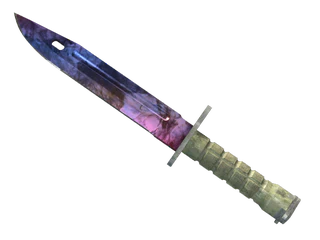
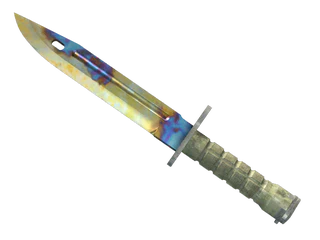
Top-tier grail demand meets a capped float profile, so the clean copies dominate attention and trade deep. Supply is limited by case origin and rarity, and recent softer moves have left opportunistic windows for sellers who watch the clean end.

Top-tier grail demand meets a capped float profile, so the clean copies dominate attention and trade deep. Supply is limited by case origin and rarity, and recent softer moves have left opportunistic windows for sellers who watch the clean end.



This is a grail-tier bayonet with a covert pedigree, priced and traded at the very high end of the market. Buyers are selective and deliberate; when a clean copy appears it draws the serious collector or tryhard buyer rather than casual traffic. For a seller that means listings sit until the right eyes catch the finish and phase.
The ladder is capped and shows a concentrated payout near the clean end with a sharp drop into the rest of the band. It is not a gentle slope: value compresses quickly once you leave the top tier, creating a tight upper bracket and a wider body below. Watch the cap when you set expectations for sale timing.
Mid-to-clean floats still give the most visible skin for the money, but the marginal payoff flattens before the worn looks get interesting. Sellers will find the best exchange between appearance and realized cash in the cleaner half of the ladder, where buyers notice the doppler finish and phase clarity. Lower-float copies past that inflection are rarely worth chasing unless the phase and pattern line up.
Listing tags and sticker prices often sit above what a seller actually nets because buyers anchor on the rare clean copies and the market makes a jumpy top. The spread widens when clean examples are scarce and contracts when more copies filter through, so you can expect a delta between ask and cashout that reflects that jumpy upper bracket. Price your net ambitions against the actual filled orders, not headline listings.
The anodized multicolored finish rewards a clean face; tiny scratches and edge wear dull the signature shimmer and buyers notice. Visual degradation is pronounced compared with plain finishes, so float movement into the lower band erodes appeal faster than on muted skins. Clean faces command attention; everything else trades more like a body copy.
StatTrak copies exist and behave like their own lane: demand follows the same concentrated top-end interest but with separate liquidity. StatTrak attracts different buyers and often clears slower, so expect a distinct premium curve and wider listing dispersion than non-StatTrak. Treat StatTrak as a parallel market when you price and time a sale.
Phase and seed matter here; Phase 3 carries the look buyers chase and any favourable seed that sharpens the green sheen will lift bids beyond float alone. Check the exact phase and the blade pattern before you set a firm asking price-buyers will pay extra for the classic doppler wave and for seeds that make the green pop. Overlooking seed will leave money on the table when a collector wants that rare visual.
The green-first palette and anodized multicolored finish read aggressive in-game, especially on darker maps where the green catches light. The contrast between the deep tones and the multicolored sheen makes the bayonet stand out on peeks and sprays, which is exactly what buyers who value visual punch are after. Valve's designer stamp shows in a finish that keeps drawing second glances.
It drops from the Gamma Case, which constrains supply relative to older, more ubiquitous containers. Case origin matters to collectors and to traders watching supply cadence; fewer drops from this source tightens the available pool and amplifies the grail status. For sellers that scarcity is the baseline assumption.
This skin has a wide historical band between low and peak transactions, reflecting episodic demand and a tight top tier. Prices have swung across that band as clean copies appear and vanish from the market, so historical movement should be read as broad rather than narrow. Expect the band to be large enough that timing and condition materially change outcomes.
With a wide all-time band and a steep upper ladder, the trading profile is jumpy rather than placid; short windows produce outsized moves when clean examples trade. Downward pressure over the past year combined with recent soft upward nudges makes timing important - a quiet week can turn fast when a fresh clean copy surfaces. If you need certainty, aim for a buyer who understands the grail dynamics.
The usual errors are treating all copies the same and ignoring phase and seed when pricing, or listing to the top without accounting for the capped float shape. Mislabeling StatTrak versus non-StatTrak or glossing over a dull blade will cause listings to stagnate. Verify the phase, float cap, and active spreads before you post and your turnover will improve.