CS2 Float & Wear Explained

Table of Contents
A CS float is the permanent 0.00–1.00 number that sets a CS2 skin’s exact wear. Lower float usually means cleaner paint. Higher float usually means more scratches, fading, and finish loss. The five exterior names in your inventory, such as Factory New or Field-Tested, are broad labels built from that one number.
Float matters because two skins in the same exterior can look and sell very differently. A 0.151 Field-Tested skin sits just inside FT. A 0.379 FT copy is almost Well-Worn. The name is the same, but the visual condition, trade-up usefulness, and buyer demand may not be.
Item facts, rarity, float caps, and collection details come from the CS2 item database. Market levels are approximate as of 2026.
CS2 float wear tiers
Every standard CS2 skin exterior fits into one of five float ranges.
The boundaries matter. Exact cutoff values belong to the more worn tier:
0.070000is Minimal Wear, not Factory New.0.150000is Field-Tested, not Minimal Wear.0.380000is Well-Worn, not Field-Tested.0.450000is Battle-Scarred, not Well-Worn.
That can create a meaningful price jump from a tiny decimal change. A 0.0699 Factory New skin and a 0.0700 Minimal Wear skin may look almost identical, but buyers filter by exterior name first.
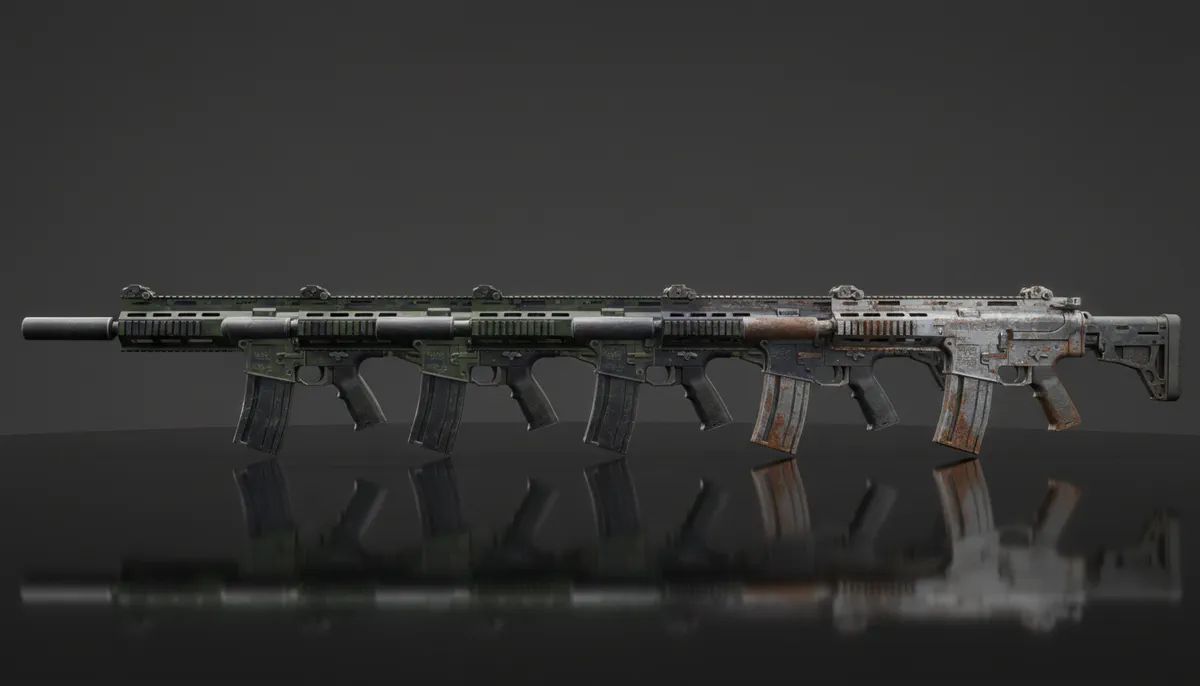
A lower float does not automatically mean a better-looking skin in every situation. Wear lands differently across finishes. Some skins lose paint across large, visible panels. Others stay attractive well into Field-Tested. Always inspect the exact copy instead of treating the exterior label as the full story.
Float caps and why some skins cannot be Factory New
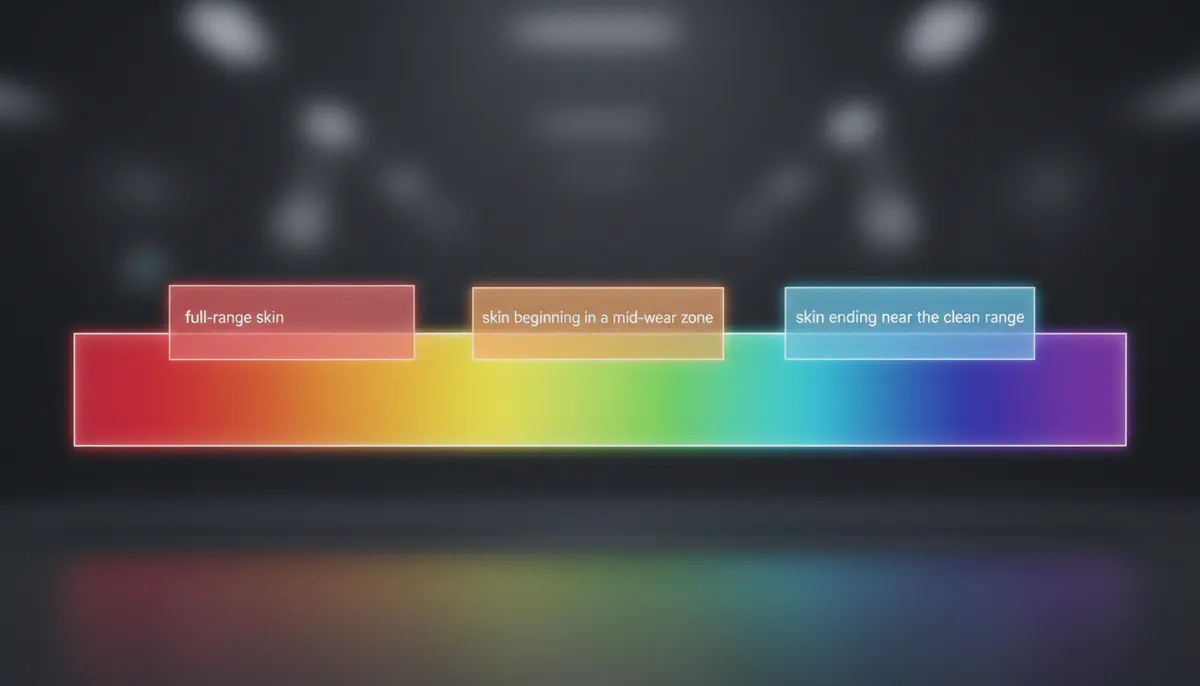
A float cap is the skin-specific minimum and maximum wear range set in its item definition. It decides which parts of the standard 0.00–1.00 scale that finish can actually roll.
For example, a skin with a minimum float of 0.18 cannot be Factory New or Minimal Wear. Its cleanest possible copy is Field-Tested. A finish with a maximum float of 0.08 can only exist in Factory New or a very narrow Minimal Wear range.
A tier exists only if the skin’s allowed float range overlaps it.
The important correction is simple: a maximum cap of 0.60 does not remove Battle-Scarred. Battle-Scarred begins at 0.45, so a 0.45–0.60 version is still possible.
Here are three useful examples.
AWP | Asiimov: 0.18–1.00
The AWP | Asiimov starts at 0.18. That sits inside Field-Tested.
- Factory New is impossible.
- Minimal Wear is impossible.
- Field-Tested exists from 0.18 to 0.38.
- Well-Worn and Battle-Scarred are both possible.
This is why an AWP | Asiimov cannot be FN or MW. A lower FT float is usually the cleaner and more desirable version, but it is still not a Minimal Wear skin.
AK-47 | Redline: 0.10–0.70
The AK-47 | Redline cannot roll below 0.10.
- Factory New is impossible.
- Minimal Wear exists only from 0.10 to 0.15.
- FT, WW, and BS all exist.
- The BS range stops at 0.70.
That narrow 0.10–0.15 MW window matters. Minimal Wear is the best exterior obtainable for the finish, which helps explain why MW Redlines often sit far above ordinary FT copies.
AWP | Fade: 0.00–0.08
The AWP | Fade shows the other side of float caps.
- Factory New is possible.
- Minimal Wear is possible only from 0.07 to 0.08.
- Field-Tested, Well-Worn, and Battle-Scarred are impossible.
A Minimal Wear AWP | Fade can exist, but it cannot be 0.12 MW. Its upper cap ends at 0.08.
How float and wear move skin price
Float changes value most often in four situations: an exterior boundary, a visually sensitive finish, an extreme float, or a useful trade-up input.
Exterior jumps are often bigger than visual changes
The market usually treats exterior names as separate categories. That makes the edges important:

Sell your CS2 skins for real money.
A 0.150x FT skin can be a practical value target. It may look close to MW while remaining in the cheaper FT category. The reverse is true for sellers holding a 0.149x MW item. Its float may be high for MW, but the exterior label can still carry more liquidity than FT.
Very low floats can earn collector overpay
A 0.003 Factory New skin is not just FN. It is close to the cleanest end of FN. On a desirable finish with visible wear, that can matter.
The biggest premiums usually appear when several factors overlap:
- The finish is in demand.
- Low float visibly improves it.
- The skin has few FN copies because of its cap.
- The float is in the 0.00x or 0.000x range.
- The copy has a strong database rank among known items.
- The float works well for a deterministic trade-up, meaning a crafting contract that uses skins to create a higher-rarity output.
“Lowest float” should be handled carefully. A float database can only rank inspected copies. The accurate wording is lowest known float or #1 in that database, not an absolute claim about every uninspected item.
The premium is not universal. A low-float commodity skin may receive little or no overpay. A high-demand collector finish or unusually useful trade-up input can be very different.
High floats can also have a market
Battle-Scarred is usually the lower-priced exterior. That is a broad rule, not a law.
Some finishes develop unusual darkening, scar placement, or heavily worn visual styles at high float. These copies can attract collectors even when a normal BS version is discounted. The buyer pool is smaller, so the item can be harder to price and slower to sell.
For a fast valuation, separate a normal high-float item from an actual collector variant. A 0.98 float alone does not guarantee premium.
Price feel: the finish and cap still lead
Float explains part of a skin’s value, not all of it.
An ordinary AK-47 | Redline in FT, WW, or BS can sit roughly in the $20–$60 range, while MW is often around $100–$250 because it is the best obtainable exterior. An ordinary FT AWP | Asiimov has commonly been around the low-$100s, despite FN and MW being impossible.
At the collector end, a Battle-Scarred AWP | Dragon Lore can still be around $4K–$5K. The finish’s limited supply and demand matter more than the fact that it is worn. M4A4 | Howl is also different from a standard high-tier finish. It is Contraband, and no new copies drop after the art dispute that removed it from the Huntsman Case.
Float is not rarity, pattern, or StatTrak
Float answers one question: how worn is the skin? It does not tell you the item’s rarity, its paint layout, or whether it tracks kills.
Rarity is the color tier assigned when a case item drops. Mil-Spec, Restricted, Classified, and Covert are weapon-skin rarity labels. Covert is the top rarity for ordinary weapon skins. Knives and gloves are Extraordinary (★) items, not Covert.
Every weapon case uses the same tier odds:
A case key in the US client store has a fixed $2.49 pre-tax price. That is not a global price or a market price. Regional pricing and tax vary.
A pattern index, also called a seed, is a separate number that controls the paint layout. Float sets wear. Pattern sets where colors and textures land.
That distinction is crucial for Case Hardened items. A blue gem is a Case Hardened pattern with unusually high blue coverage. Community tiers for blue coverage are conventions, not official Valve categories. Well-known examples include Karambit | Case Hardened pattern #387 and AK-47 | Case Hardened pattern #661. One seed out of 1,000 is roughly 0.1% of that skin’s drops, but a seed says nothing about the item’s float or StatTrak status.
Doppler finishes work the same way. Phase 1 through Phase 4, plus Gamma Doppler equivalents, are paint layouts rather than float tiers. Valve has never published phase frequencies. Community inventory samples suggest ordinary phases are roughly comparable in frequency, while Ruby, Sapphire, and Black Pearl are the rare outcomes. Published estimates differ, and Black Pearl is generally considered rarer than Ruby or Sapphire.
Knives can have a StatTrak version, meaning the item records kills. Gloves cannot.
Related reading: Chroma 2 Case: Skins, Odds & Value, Fever Case: Skins, Odds & Best Drops, and the Karambit Blue Gem: Pattern & Price Guide.
How to check a skin’s float before you buy or cash out
Do not rely only on Factory New, Minimal Wear, or Field-Tested in a listing title. Check the exact float.
- Open the skin in your Steam inventory.
- Select Inspect and copy the inspect link.
- Paste the link into a reputable float checker.
- Review the precise float, pattern index, skin-specific float cap, and any available float ranking.
- Compare recent completed sales of similar floats, not just the highest current listing.
For marketplace listings, copy the Inspect in Game link before paying a premium. A listing marked FN could be a desirable 0.001 copy or a common 0.069 copy. Both are FN, but they should not automatically be valued the same.
Before an instant cash-out, inspect first if the skin has an unusual low float, high float, pattern seed, stickers, or trade-up relevance. Those traits can change the value beyond the standard exterior price. For ordinary skins, though, the exact float often matters far less than the wear tier and current liquidity.
FAQ
What is a CS float?
A CS float is a permanent 0.00–1.00 wear value assigned to a skin. Lower values usually look cleaner, while higher values usually show more wear.
Does a CS2 skin float get worse from using the item?
No. Gameplay, kills, trading, and item age do not change float. The value is assigned when the item is generated.
Is 0.07 Factory New?
No. A float of 0.070000 is Minimal Wear. Factory New is 0.00 up to, but not including, 0.07.
Why can some skins never be Factory New?
Each finish has its own minimum and maximum float cap. If a skin starts above 0.07, it cannot be Factory New. An AWP | Asiimov starts at 0.18, so its cleanest possible exterior is Field-Tested.
Does lower float always make a skin more expensive?
No. Low float can add value, especially near clean extremes, but many ordinary skins receive little overpay within the same exterior. Finish demand, supply, pattern, stickers, and trade-up utility can matter more.
Are float and pattern index the same thing?
No. Float controls wear. Pattern index, also called seed, controls paint placement, including Case Hardened blue coverage, Doppler phase, and fade percentage.